


Every golfer eventually learns one hard truth: most strokes in a round happen on the green. According to data from the PGA Tour’s ShotLink system, players take roughly 40–45% of their total strokes with a putter. That means the club you use on the green can have a bigger impact on your score than your driver.
A golf putter is a specialized club designed to roll the ball smoothly across the green and into the hole. Unlike drivers or irons, putters focus on precision, control, and alignment rather than power.
But here’s the challenge: not all putters are the same. Differences in head shape, putter balance, weight distribution, and alignment design can change how the club performs.
Many golfers struggle with missed short putts, poor distance control, or inconsistent alignment. Often, the issue is not skill—it is using the wrong putter for their stroke style.
This complete golf equipment guide for 2026 explains how to choose the right putter based on science, player data, and modern club design. You will learn:
- The difference between mallet vs blade putter designs
- How putter balance affects your stroke
- Which features improve accuracy and consistency
- What modern fitting research says about putter performance
If you want to lower your score without changing your entire swing, choosing the right putter is one of the smartest equipment decisions you can make.
How Do You Choose the Right Golf Putter?
Short answer: Choose a putter based on your stroke path, preferred alignment style, and the putter’s balance and head design.
The biggest mistake beginners make when buying a putter is choosing purely based on looks or brand popularity.
Modern club fitting research shows that stroke mechanics determine the best putter style.
Golfers typically fall into three stroke categories:
- Straight-back straight-through stroke
- Slight arc stroke
- Strong arc stroke
The putter’s design must match the natural arc of your putting stroke.
| Stroke Type | Recommended Putter Type | Typical Balance |
|---|---|---|
| Straight-back straight-through | Mallet putter | Face-balanced |
| Slight arc | Blade or compact mallet | Moderate toe hang |
| Strong arc | Traditional blade | High toe hang |
Matching putter balance to stroke path improves face control at impact, which directly affects accuracy.
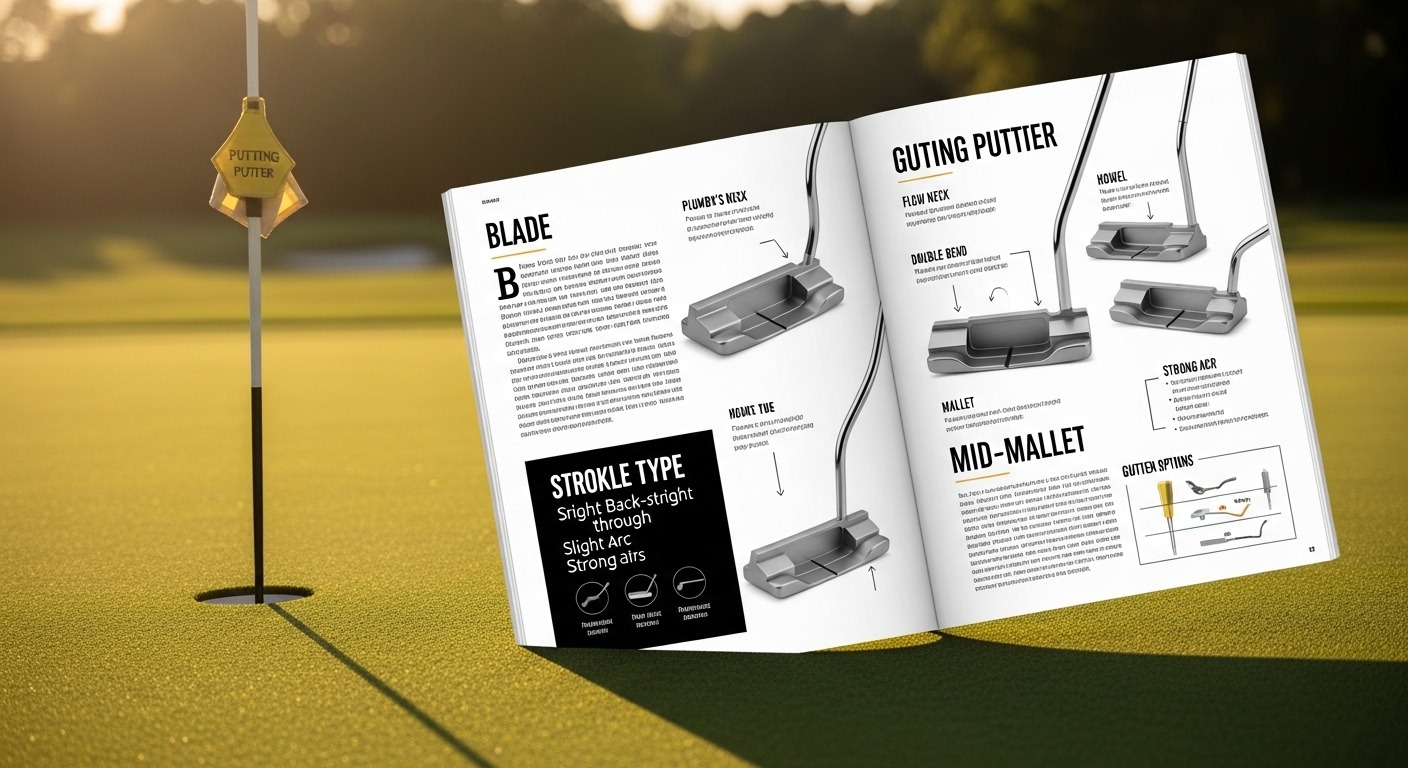
Mallet vs Blade Putter: Which One Is Better?
Short answer: Mallet putters provide more stability and forgiveness, while blade putters offer better feel and control for players with an arcing stroke.
The debate between mallet vs blade putter designs is one of the most common questions in golf equipment discussions.
What Is a Blade Putter?
A blade putter features a thin, traditional head shape with weight distributed closer to the center.
Key characteristics:
- Compact design
- Greater feedback on impact
- Better suited for players with an arc stroke
- Preferred by many professional golfers
Because blade putters are lighter and less forgiving, they require precise contact and consistent stroke mechanics.
What Is a Mallet Putter?
A mallet putter uses a larger head shape with weight distributed across the perimeter.
Key benefits include:
- Higher forgiveness on off-center hits
- Improved stability through impact
- Better alignment features
- Higher moment of inertia (MOI)
Many modern putters use mallet-style designs because they reduce twisting when the ball is struck away from the sweet spot.
According to a Ping engineering study, high-MOI putters can reduce face twisting by up to 30% compared to traditional blades.
What Is Putter Balance and Why Is It Important?
Short answer: Putter balance determines how the club face behaves during the stroke and must match your putting motion.
When discussing putter balance, golfers typically refer to two main categories:
- Face-balanced putters
- Toe-hang putters
Face-Balanced Putters
When you balance the shaft of a face-balanced putter on your finger, the face points upward toward the sky.
This design keeps the clubface square during the stroke.
Best suited for:
- Straight-back straight-through strokes
- Beginners seeking stability
- Players who struggle with face rotation
Toe-Hang Putters
Toe-hang putters rotate downward when balanced.
This design allows the clubface to open and close naturally during an arc stroke.
Best suited for:
- Players with a natural putting arc
- Golfers seeking more feel and control
- Traditional blade putter users
What Length Should Your Golf Putter Be?
Short answer: Most golfers use a putter between 33 and 35 inches, but the correct length depends on posture and eye position.
Using the wrong putter length can affect alignment and stroke mechanics.
Proper fit ensures:
- Your eyes sit directly over the ball
- Your arms hang naturally
- The putter sole rests flat on the green
| Golfer Height | Recommended Putter Length |
|---|---|
| Below 5’6″ | 32–33 inches |
| 5’6″ – 6’0″ | 33–34 inches |
| Above 6’0″ | 34–35 inches |
Professional club fitting often uses motion tracking systems like SAM PuttLab to analyze stroke mechanics and determine ideal length.
How Does Putter Weight Affect Performance?
Short answer: Heavier putters improve stability and distance control, while lighter putters increase feel and feedback.
Modern putter design focuses heavily on weight distribution.
Typical putter head weights:
- 330–340 grams: traditional feel
- 350–370 grams: modern high-stability design
- 380+ grams: counterbalanced putters
Heavier heads help maintain a smooth stroke on slower greens.
Lighter putters often perform better on faster greens where touch is critical.
What Alignment Features Help Improve Putting Accuracy?
Short answer: Alignment aids help golfers square the face to the target line and improve consistency.
Research from Golf Digest’s equipment testing program shows that golfers miss short putts primarily due to poor face alignment.
Common alignment features include:
- Single sight lines
- Triple alignment lines
- Contrasting colors
- Large mallet alignment frames
Mallet putters typically offer more advanced alignment systems.
This is one reason they have become increasingly popular among both amateurs and professionals.
Do Professional Golfers Prefer Blade or Mallet Putters?
Short answer: The PGA Tour currently shows a near-even split between blade and mallet putters.
Historically, blade putters dominated professional golf.
However, modern performance data has increased adoption of mallet designs.
Recent tour usage trends:
- Blade putters: ~55%
- Mallet putters: ~45%
Many players choose based on visual confidence and stroke compatibility rather than trends.
For example:
- Some major champions rely on traditional blade putters
- Others use high-MOI mallet designs for stability
This demonstrates an important point: the best putter is the one that fits your stroke.
Should Beginners Choose a Mallet or Blade Putter?
Short answer: Beginners usually benefit from mallet putters because they offer greater forgiveness and easier alignment.
New golfers often struggle with:
- Keeping the face square
- Consistent contact
- Distance control
Mallet putters address these issues through:
- Higher MOI stability
- Improved alignment visuals
- Larger sweet spots
Because of these advantages, many instructors recommend mallet putters for players learning the game.
Conclusion: How Do You Choose the Best Golf Putter in 2026?
Choosing the right putter is one of the simplest ways to improve your golf performance.
Unlike drivers or irons, putting is less about power and more about precision, confidence, and consistency.
When buying a putter in 2026, focus on these key factors:
- Match the putter to your stroke type
- Understand the difference between mallet vs blade putter designs
- Select the correct putter balance
- Choose proper length and weight
- Use alignment features that improve accuracy
Golf equipment technology continues to evolve, but the fundamentals remain the same: the best putter is the one that helps you consistently start the ball on the correct line.
Call to Action:
If you are serious about lowering your score, consider getting a professional putter fitting or testing different designs on the practice green. The right putter could save several strokes per round and transform your performance on the green.
Frequently Asked Questions About Golf Putters
1. What is the difference between a mallet and blade putter?
A blade putter has a traditional narrow head and provides more feel for players with an arcing stroke. A mallet putter has a larger head with perimeter weighting, offering greater forgiveness and stability.
2. What putter balance is best for beginners?
Face-balanced putters are typically best for beginners because they help keep the clubface square during the stroke, reducing directional errors.
3. How much should a good golf putter cost?
Quality putters usually range from $120 to $400. Premium models with advanced materials and high-MOI designs can exceed this range.
4. Does putter weight affect distance control?
Yes. Heavier putters can improve stroke stability and distance control on slower greens, while lighter putters provide more feel on fast greens.
5. Should I get custom fitted for a putter?
A professional putter fitting can analyze stroke path, face angle, and tempo using motion tracking systems. This helps determine the best putter length, balance, and head style.
6. Are expensive putters better?
Not necessarily. Performance depends on fit and compatibility with your stroke rather than price alone.
7. How often should you replace a putter?
Putters can last many years because they experience minimal wear. Most golfers replace them only when upgrading technology or changing stroke style.
Read More Also: How to Move a Mobile Home for Free: A Step-by-Step Guide

