


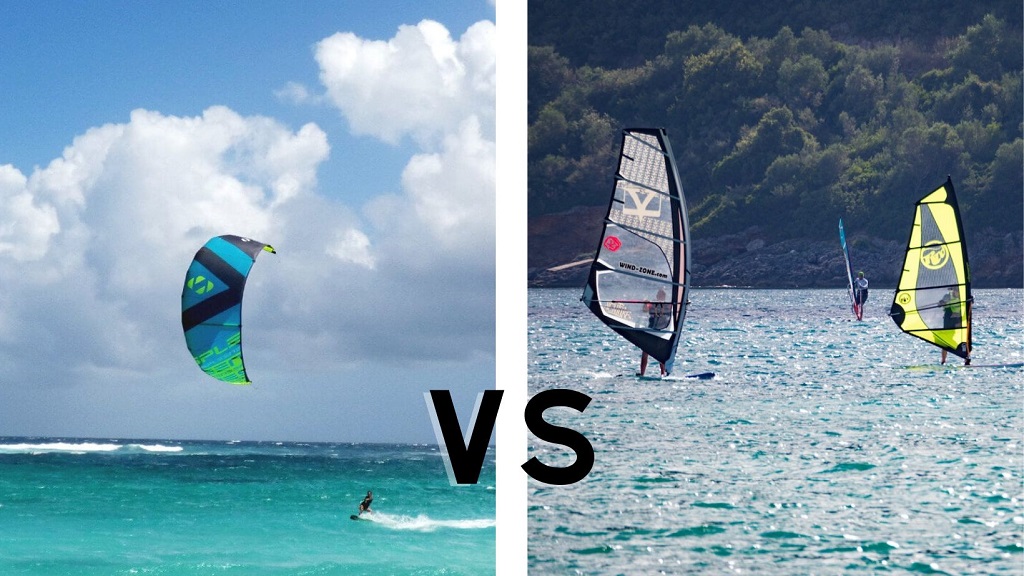
Windsurfing and kitesurfing are two popular action water sports that involve using the power of the wind to propel you across the water while standing on a board. Both sports provide an adrenaline rush and allow you to harness the wind and waves, but each has unique characteristics. Here’s an in-depth look at the differences between windsurfing vs kitesurfing to help you decide which is correct. The key differences between windsurfing and kitesurfing.
| Windsurfing | Kitesurfing | |
| Learning curve | Moderate – Can ride basics in 8-20 hours | Steep – Takes 15-30+ hours to gain control skills |
| Cost to get started | $1500 – $2500 | $3000+ |
| Ideal wind range | 12 – 35 knots | 10 – 45+ knots |
| Maximum speed | 25-35 mph | 45-50+ mph |
| Jumping ability | Moderate jumps | Big air potential |
| Upwind efficiency | Poor – must zigzag | Excellent due to kite lift |
| Safety risk | Low-moderate once trained | Moderate-high until skills mastered |
| Physical intensity | Moderate upper body | High upper and lower body |
| Portability | Challenging – long board and sail | Easy – compact bags for gear |
| Age to start | 5+ years old | 12+ years old recommended |
| Progression | Steady skills development | Longer initial learning then rapid skills growth |
| Social scene | Strong global community | Very social at kite beaches |
Overview of Windsurfing

Windsurfing, also called sailboarding, has been around since the 1970s. It involves standing on a surfboard-like sailboard and controlling a giant sail that harnesses the wind to propel you across the water. The sailboard is slightly larger than a traditional surfboard to provide more stability and has a daggerboard that can be lowered into the water to prevent sliding sideways.
The sail is held upright by extending your arms over your head to grab onto the mast and boom. You can control the direction and speed by turning the sail and adjusting your stance and weight distribution. More advanced windsurfers can get air off waves and perform jumps and tricks. Windsurfing requires core strength, balance, and agility to maneuver the board and sail.
Pros of Windsurfing
- Accessible for beginners – Windsurfing has a relatively quick learning curve compared to kitesurfing. You can be on board and sail on day one.
- More affordable – Getting started with windsurfing requires less expensive gear than kitesurfing. Boards can be rented until you’re ready to buy.
- Safer – Windsurfing doesn’t involve the complexity of managing a high-powered kite, so the risks of injury or getting into a dangerous situation are lower.
Cons of Windsurfing:
- Physical demands – Controlling the sail takes strength and endurance, especially in high winds. Your arms can get fatigued.
- Limited speed – Windsurfers generally max out around 20-30 mph. The power of the sail has a limit.
- It’s not great upwind – It’s challenging to sail upwind on a windsurf board. You zigzag to make progress upwind.
- Bulky gear – Transporting and storing a long board and sail is less convenient than a kite.
Overview of Kitesurfing
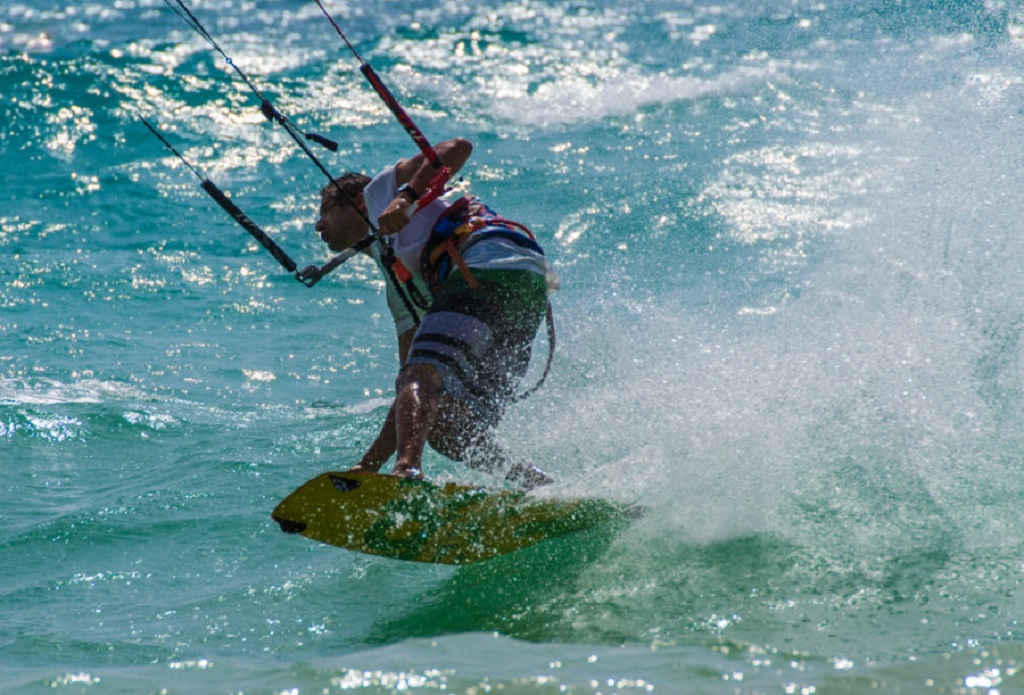
Kitesurfing emerged in the 1990s and has increased in popularity. Also known as kiteboarding involves using a large, inflatable power kite controlled via a bar and lines to propel you across the water on a small surfboard-like board. The kite is designed to generate pull and lift, allowing you to catch air off waves.
Riders wear a harness attached to the control bar lines that spreads out the kite’s force for better power and steering. Manipulating the kite and edges of the board allows impressive speed and height. Kitesurfing requires excellent balance, core strength, and kite control skills.
Pros of Kitesurfing:
- Extreme speed – Kitesurfers can reach speeds over 45 mph when powered by strong wind. The kite provides more raw power for speed.
- Big air – Experienced kitesurfers can get massive air off waves, performing high jumps, rotations, and flips at the elite level. It provides a greater thrill and adrenaline rush.
- Upwind ability – The lift from the kite makes it relatively easy to sail upwind efficiently. You don’t have to zigzag like with windsurfing.
- Compact, portable gear – Kites, boards, and bars pack small for travel and storage. You can take them on an airplane easily.
Cons of Kitesurfing:
- Steep learning curve – It can take 20+ hours of lessons before you can safely control the kite. The risks of losing control are higher.
- Dangerous if not appropriately handled – Kites are extremely powerful. Riders need proper training to avoid accidents and injury.
- More expensive startup costs – A full kiteboarding setup costs around $3000+ to purchase versus $1000+ for windsurfing gear.
- Not ideal for light winds – Unlike windsurfing sails, most kites don’t perform well in winds under ten mph. They need stronger wind to work correctly.
Gear Comparison
The equipment you need for windsurfing vs kitesurfing differs quite a bit, which affects the cost, portability, and performance.
Windsurfing Gear
- Board – Larger and more comprehensive than a surfboard. They range from 240-370 cm long. Beginners use wider, sturdier boards.
- Sail – Made of monofilm or laminated sailcloth. They range from 3.5 to over 7 meters. More giant sails require more wind.
- Mast – Connects the sail to the board. Length ranges from 390-480 cm. Made of aluminum or carbon fiber.
- Boom – You hold the bar to control the sail angle. Length ranges from 160-190 cm.
- Universal joint – Connects the mast and boom so the sail can rotate.
- Daggerboard – Extends into water underboard for upwind stability.
- Footstraps – Straps to lock feet into optimal position.
Kitesurfing Gear
- Kite – Inflatable power kite with four lines. Sizes range from 5 to 20 meters—more giant kites for stronger wind.
- Control bar – Holds kite lines for steering. Has a safety release system. Attached to the harness.
- Lines – 20-30 meter long lines that connect the kite to the bar.
- Board – Smaller and narrower than a windsurf board. Range from 240-250 cm long.
- Harness – Spreads kite force. Hooks to the control bar. Straps around waist and legs.
- Pumps – For inflating kites and keeping them rigid.
Learning Process
Picking up these sports requires significantly different time, instruction, and progression investments before you can ride independently.
Learning Windsurfing
- Learning the basics and riding in light wind takes 8-20 hours.
- Get a feel for the board’s balance before adding the sail.
- Start in very light winds around 5 knots or less.
- Learn stance, foot positioning, and steering the board.
- Add the sail and get used to power control.
- Practice hauling the sail, tacking upwind, turning, and leaning out over the water.
- Build up to riding in 12- 25 knot moderate breezes in 4-6 foot waves.
- Take lessons to correct technique and improve faster.
Learning Kitesurfing
- It takes 15-25+ hours before you can ride safely and control the kite.
- Start with kite control lessons on land. Learn to launch, steer, power up, and depower.
- Master flying and landing the trainer kite.
- Advance to using a full-size kite with trainer lines attached to an instructor.
- Get comfortable controlling the kite in various wind conditions.
- Once kite skills are solid, start maneuvering the board.
- Stick with lessons until you have complete control in winds up to 20 knots.
- Requires many hours of practice in varying conditions to become proficient.
Conditions
Windsurfing and kitesurfing require overlapping conditions, but kites are designed for a broader range of wind speeds.
Windsurfing Conditions
- Ideal in 12-25 knot winds, which is moderate to strong breeze.
- Minimum 5-7 knots for light wind sailboards. It cannot sail in very light wind.
- Maximum around 35 knots in a mighty wind. It is challenging to control the sail.
- Works well in small chop, swell, and ocean waves from 1-6 feet.
Kitesurfing Conditions
- Designed for winds from 10 to 45+ knots, a more comprehensive range than windsurfing
- Can launch and ride slowly in 10 to 15-knot light winds.
- Ideal conditions are 15 to 25 knots moderate to strong winds.
- Advanced riders harness 25 to 45+ knot storm-strength winds.
- Ride waves from 1 to over 15-foot faces.
- It’s impossible in very light winds under 10 knots when kites lose power.
Locations
Both sports are best on large open water bodies with steady side or side/onshore winds and rideable waves.
Top Windsurfing Locations
- Hawaii – Consistent trade winds and waves at spots like Hookipa Beach.
- Hood River, Oregon – Strong Columbia River Gorge winds all summer.
- La Ventana, Mexico – Warm, steady wind in winter.
- Maui – Windsurf capital of the world. Many spots to choose from.
- The Great Lakes – Large bodies of water whip up good wind.
Top Kitesurfing Locations
- Cape Hatteras, NC – Windy Outer Banks combined with shallow sound side.
- Maui-Kite Beach offers excellent learning conditions and wave riding.
- Virgin Islands – Steady trade winds and islands to explore.
- Tarifa, Spain – The windsurfing mecca also draws kiters.
- Cabarete, Dominican Republic – Legendary for its wind and waves.
Exercise Benefits
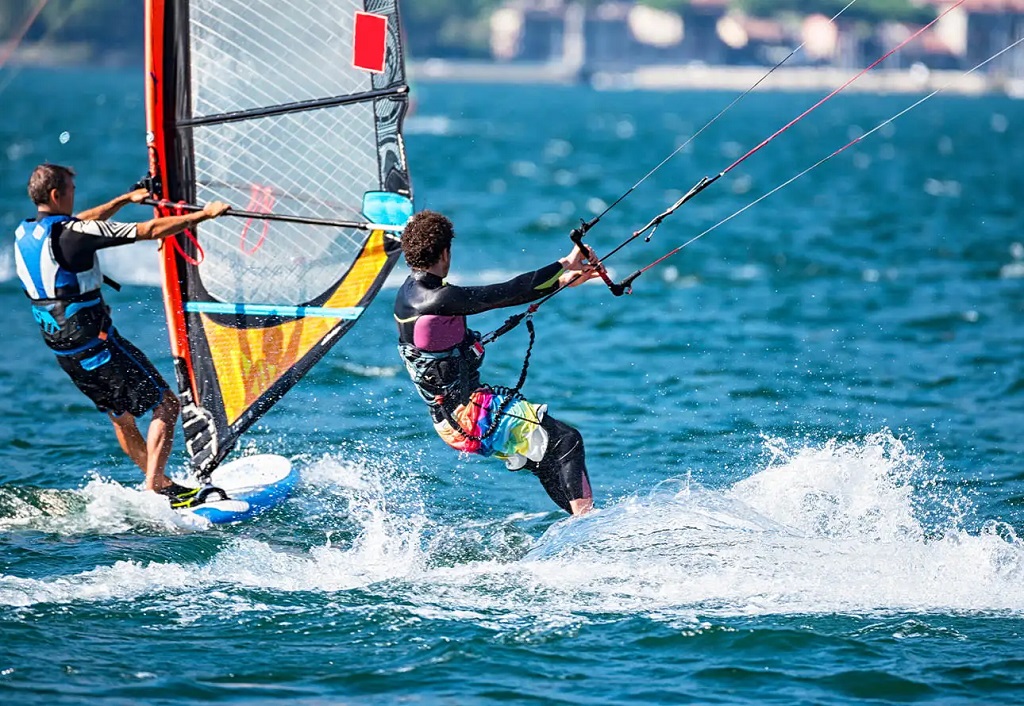

Both wind-powered board sports offer great exercise and health benefits. Kitesurfing demands greater fitness.
Windsurfing Exercise
- Works core stabilizer muscles to balance on the board.
- Tones upper body from lifting and holding up the sail.
- Legs get a workout controlling turns and edging.
- Aerobic exercise for sustained time on the board. It gets the heart pumping.
- Works coordination, balance, agility, and reflexes.
Kitesurfing Exercise
- Extreme core and leg workout maneuvering the board at high speed.
- The upper body gets a serious strength exercise from controlling the kite.
- Works arms, shoulders, back, abs, and legs intensely.
- Provides a killer cardio workout. Builds endurance and stamina.
- Demands tight coordination between kite, board, and balance.
- It is physically demanding on both the upper and lower body.
Risk and Safety
Understanding the risks of these sports and how to stay safe on the water is essential. Caution and lessons reduce the dangers.
Windsurfing Risks
- Capsizing and getting tangled in gear if unable to unclear sail.
- Collisions with other water users.
- Head trauma from sail mast when capsizing. Wear a helmet.
- Fatigue leads to drifting into hazardous areas.
- Dehydration and sun exposure on warm days.
Kitesurfing Risks
- Powerful kite accelerating riders to unsafe speeds. Use a kite leash.
- They were being lifted uncontrollably into the air or dragged in the water. Don’t exceed ability.
- Hard crashes from failed jumps. Avoid overpowered jumps.
- Collision with objects or other riders. Look before turning/jumping.
- Injury if tangled in lines. Keep a first-aid knife handy.
Costs
Buying all the gear you need is pricey for either sport. Kitesurfing has a significantly higher startup cost.
Windsurfing Startup Costs
- Beginner board – $700 to $1000
- Beginner sail – $400 to $700
- Universal joint and accessories – $250
- Neoprene wetsuit – $200
- Harness and vest – $150
- TOTAL: Around $1700 to $2300
Kitesurfing Startup Costs
- Beginner training kite package – $400 to $600
- Medium-size main kite – $1000 to $1500
- Board – $500 to $800
- Harness and control bar – $450
- Neoprene wetsuit – $200 to $300
- TOTAL: Around $3000 to $4000
Intermediate vs Advanced
Once you progress beyond the basics, recreational and expert riding differences become more apparent.
Intermediate Windsurfing
- Ride upwind efficiently by edging and tacking.
- Control sail power in high wind conditions.
- Footswitch sail instead of hauling.
- Start riding waves and attempting jumps.
- Handle choppier water and stronger gusts.
- Perhaps invest in a shorter “carving” board.
Advanced Windsurfing
- Handle overpowered sails and boards.
- Ride big waves smoothly, moving up and down the face.
- More consistently land basic jumps.
- Practice duck jibe turns for smooth direction changes.
- Manage complex multi-sail rigs and foiling boards.
Intermediate Kitesurfing
- Confidently revive kites from water and handle emergencies.
- Ride upwind, downwind, and across broad ranges.
- The transition between riding unhooked and edge to edge.
- The control board is in choppy water and gusty conditions.
- Load and pop off waves for air.
Advanced Kitesurfing
- Control kites skillfully in extremely high winds.
- Perform directional changes using hooked-in kite loops.
- Consistently land big air jumps and grab tricks.
- Ride foil boards upwind at high speeds.
- Handle waves and ocean swells efficiently.
- Maintain speed and control in all conditions.
Social Scene
While either sport can be enjoyed solo, windsurfing and kitesurfing have vibrant social communities.
Windsurfing Community
- Windsurf clubs provide events, clinics, and social activities.
- Competitions like Formula Windsurfing bring riders together.
- Windsurf camps are a great way to travel and make friends.
- Windsurfing destinations attract an international mix of riders.
- Veterans are eager to share knowledge with beginners.
Kitesurfing Community
- Kite beaches draw a crowd of riders who chat between sessions.
- Kiting forums and groups help find travel buddies.
- Wave riding “sessions” bring good vibes.
- Competitions like Red Bull King of the Air are social events.
- Experienced riders mentor newcomers.
Popularity and Growth
Windsurfing peaked in the 1980s and 90s, while kitesurfing has exploded in popularity this century. But windsurfing retains a steady following.
Windsurfing Popularity
- Experienced decline after peaking decades ago.
- There are still over 1 million active windsurfers.
- Remains popular in established regions like Hawaii.
- Draws dedicated participants who stick with the sport.
- Advances in gear like foiling boost interest.
Kitesurfing Popularity
- Has increased since the 90s. Now an estimated 2.5 million liters.
- Popular among youth and expanding with innovations.
- Massive increase in women taking up kitesurfing.
- She dominated competition scenes like the Red Bull King of the Air.
- Continues trending upward as equipment improves.
Is One Better For Beginners?
For most new riders, windsurfing provides a more effortless introductory experience. But some may take to kitesurfing quicker with sufficient instruction.
- Windsurfing – Less daunting learning curve. Lower risks. It does not require expert supervision once the basics are learned. More beginner-friendly gear is available for renting and purchasing.
- Kitesurfing – Requires many hours of lessons before it is safe to practice alone. Must demonstrate competent kite skills before riding. Higher cost of instruction. Risk of serious injury if improperly trained.
- However, once skills are achieved, kitesurfing allows riding in lighter winds. Some may find riding a small board powered by a kite more intuitive than maneuvering a sail.
- Ultimately, it comes down to personal preference and access to good schools. It is best to sample both sports, if possible, when starting.
Windsurfing vs Kitesurfing: Which Is Better For You?
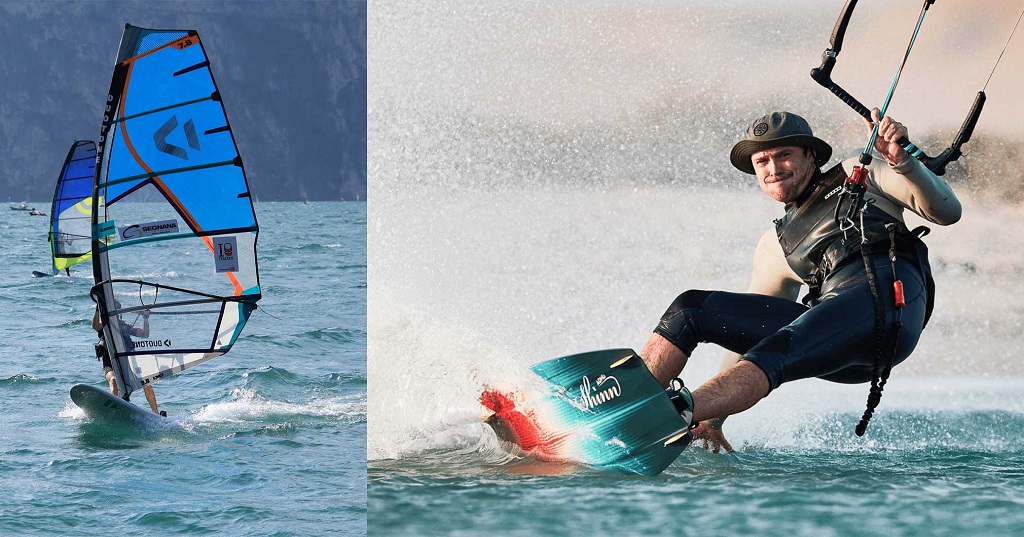

Here are some factors to help determine if windsurfing or kitesurfing better matches your goals and preferences:
Consider kitesurfing if you want:
- Maximum speed and adrenaline rush
- Big air jumps
- Ride in very light or powerful winds
- Don’t mind a longer learning curve
- Enjoy mastering complex skills
- Prefer compact storage of gear
Consider windsurfing if you want:
- Quickly get on the water as a beginner
- Spend less on gear
- Physical upper body workout
- Lower risk while building skills
- Ride moderate winds and waves
- Focus more on the water than the kite
- I already have windsurf experience
Both sports provide a blast of freedom and fun in the elements. Try them out for yourself to see which moves you!
Frequently Asked Questions
What is the recommended age for starting windsurfing or kitesurfing?
- Windsurfing – Can start as young as 5-6 with kid-sized gear. 10-14 is more common to have the necessary balance and strength.
- Kitesurfing – Minimum starting age is usually 12-15. Need maturity and coordination to manage kite safety.
Can you travel with windsurfing or kitesurfing gear?
- Windsurfing – Challenging for air travel but works for car trips. Must pack board and sail bag carefully.
- Kitesurfing – It is much easier to transport boards, kites, and bars on planes or in cars. Bags keep everything compact.
Which is easier to learn?
- For most people, windsurfing has a quicker learning curve. You can be sailing fairly quickly versus the long process of mastering kite control.
Can you do tricks on both?
- Both windsurfing and kitesurfing allow an array of aerial tricks, from jumps to rotations to slides.
- The kite’s power allows for greater air and more extreme maneuvers. But trick windsurfing remains very impressive.
Which provides a better core workout?
- Kitesurfing is recognized as demanding greater core engagement and leg strength to maneuver the board at high speeds.
- Windsurfing still utilizes core stabilizers but puts more emphasis on upper body strength to harness the sail.
Conclusion
Windsurfing and kitesurfing each offer an incredible experience that harnesses the power of the wind and waves. While kitesurfing has surged in popularity for its enormous air possibilities, windsurfing remains an excellent choice to quickly get on the water with less gear and training investment. The decision often comes down to your budget, local conditions, desire for adrenaline vs safety, and ability to commit the time needed to advance your skills. While exploring the charming town of St. Malo, nestled along the stunning coastline of Brittany, France, immerse yourself in the exhilarating world of windsurfing or kitesurfing. Both sports can provide a lifetime of enjoyment and memories. By understanding the differences between windsurfing vs kitesurfing, you’ll discover which wind-driven riding type resonates with you the most, adding an adventurous and unforgettable dimension to your St. Malo experience.